Wednesday, June 20, 2012

Historic Jumbo Mortgage Rates: Prudent Borrowers Rewarded

Jumbo Mortgage Rates continue to hover at historic lows but we have noticed a trend among investors of extreme diligence on ensuring ultra high loan quality. This weighs heavily on a client that has a complex financial picture as the time and paperwork required is a few steps removed from an IRS audit. Especially if a client owns a few companies or has creative accountants. Here are the charts that tell the story of where mortgage and select real estate markets are currently at:


Wednesday, May 23, 2012

HARP and Other Home Refinancing Options


HARP and Other Home Refinancing Options
The housing bubble of 2008 placed many homeowners in an underwater position where mortgage balances greatly exceeded a home’s actual market value. In response to these conditions, the federal government started the Home Affordable Refinance Program, or HARP.

And while HARP provides a convenient option for homeowners stuck with underwater mortgages, some homeowners may not be eligible for the program. Fortunately, there are other refinancing options available for those who don’t qualify for the Home Affordable Refinance Program.

HARP Refinancing

Homeowners unable to obtain financing due to a drop in home value may want to consider the HARP as a refinancing option. The effects of the housing bubble and resulting drops in home value left many homeowners paying considerably more in mortgage payments than before. This happened in cases where mortgage contract terms involved interest-only payment options or balloon payment arrangements.

The Home Affordable Refinance Program is designed to make mortgage payments more affordable while setting homeowners up in stable mortgage contracts. Refinancing through HARP involves an application process and underwriting review process. Applicants must also pay refinancing fees.

In order to qualify for HARP refinancing, applicants must meet the following requirements –
· Homeowners must be current on their mortgage payments and show a 12 month history of timely payments made
· Existing mortgages must be underwritten through Fannie Mae or Freddie Mac
· Existing mortgages must have been sold no later than May 31, 2009
· HARP requires a loan-to-value (amount owed vs. actual market value) ratio of 80 percent or more.

HAMP Options

The federal government offers the Home Affordable Modification Program, or HAMP as an alternative financing option for homeowners with underwater mortgages. Homeowners who have missed payments on their mortgage due to a financial hardship may qualify for HAMP assistance. Much like with HARP requirements, a person’s current mortgage must be held by Fannie Mae, Freddie Mac or any other U. S. Treasury-sponsored lenders.

In order to qualify for HAMP refinancing, homeowners must meet the following requirements –
· Current monthly payment amounts must exceed 31 percent of the homeowners gross income
· Applicants must provide proof of financial hardship
· The home must be the primary residence
· The total amount owed on a mortgage must be less than $729,750

Lenders can offer several different modification plans depending on a person’s financial situation. In most cases, a HAMP agreement includes a 90 day trial period. After the 90 days, lenders reassess the homeowner’s’ situation to see if other long-term modification arrangements are warranted.

FHA Refinancing Options

FHA refinancing options may come in handy for homeowners who can’t qualify for HARP refinancing because they’ve built up considerable equity in their home. Homeowners with existing FHA- or VA-backed mortgages loans can easily qualify for FHA financing provided they are current on their monthly mortgage payments.

The FHA actually has a streamlining process that allows homeowners with existing FHA or VA mortgages to qualify for refinancing without going through the usual credit score checks, appraisal process or proof of employment requirement. Borrowers can qualify for FHA refinancing as long as they have remained current on their mortgage payments for the past 6 months, with a limit of one late payment within the past 12 months.

With FHA loans, homeowners can finance as much as 96.5 percent of the existing mortgage amount. Lenders also lump the mortgage insurance premium costs in with the total loan amount. So, an FHA refinance can convert a mortgage with 20 years left to pay into a new 30-year loan. By doing so, homeowners can considerably lower their existing interest rates.

Considerations

When comparing HARP versus HAMP options, the terms of a HAMP mortgage agreement are actually a modification on an existing mortgage and not an actual refinancing arrangement. A HAMP loan modification lowers the monthly mortgage payment for the first five years of the loan. As of the sixth year, the mortgage interest rate increases by up to one percentage point per year. Once the mortgage interest rate reaches the market rate at the time when the agreement was prepared, the mortgage payment amount levels off for the remainder of the loan period.

Homeowners considering the FHA refinancing option may want to pay particular attention to how the upfront fees and mortgage insurance costs affect the total mortgage loan amount. In some cases, borrowers may end up paying more in interest costs by refinancing than sticking with the terms of their existing mortgage.

Provided by RMR.org.

Friday, February 10, 2012

Friday, February 3, 2012

Real Estate Deflation Machine Speeding Up?

Housing continues to fall in the majority of cities across the country. Here is a way back price drop in a premium community in Orange County, CA

This home was purchased in March 2001 from Lennar(builder) for $875k. It went pending this week at $899k.

Here is a financial profile of Coto De Caza, CA. Clearly this is a high earning and high networth area of Southern California. Yet prices keep falling....


The value of housing in most markets will continue to fall and this is despite absolute record low jumbo loan interest rates.


As always have a great weekend.

Monday, January 16, 2012

Costs Flying Sky high While Others Nearly Plummet


One way of measuring inflation is to gauge how prices for an assortment of goods and services have varied over time. Another approach involves looking at changes in how much things cost relative to what the average worker earns (the flaw with this latter method, of course, is that those who don't have jobs may find that many, if not most, of the things they might want or need to buy are unaffordable).


In searching for airline tickets over the last six months for an upcoming family vacation to Italy I have seen the broad impact of fuel costs on ticket prices since a trip two years ago. Obviously, ticket prices move on hundreds of factors but the most influential input is the cost of jet fuel. In the last decade jet fuel cost per gallon is up 3.5x from 0.87 cents a gallon to 3.01 on average globally last month. Up to 70% of an entire airlines operating budget is fuel costs.

Click image for source and up to date index information.


Be that as it may, if one assumes that data from the Bureau of Labor Statistics is even remotely close to the mark, it would appear that the purchasing power of the average worker has improved over the past 10 years, which is contrary to popular wisdom (see dotted line in the chart below).
There could be any number of reasons why perceptions differ from the reported data. Among other things, the composition of the basket of goods that the BLS uses to construct its index might not be realistic, especially in today's fast-changing economy. Or maybe the pricing information they rely on doesn't jibe with consumers' experience on the ground. Then again, a cynic might note that authorities have an incentive to underestimate inflation and overestimate wage growth for pollitical gain.
Regardless, I thought it interesting to highlight those categories that have become the least and most affordable for the average worker over the past decade. Not surprisingly, gasoline and other energy-related products are a lot more expensive in relative (and absolute) terms than they used to be, which goes some way towards explaining  the heightened demand for fuel efficient cars and why people are driving fewer miles than they used to. In contrast, it's easy to see why sales of flat screen TVs and other modern gadgets have jumped -- the products are much more affordable than they used to be.

Thursday, December 22, 2011

Wednesday, October 12, 2011

Jumbo and Conforming Loan Rate Update

Mortgage Delinquency continues to be a problem. It is our view that this could take several more years to run it's course. Average days till a home goes from first missed payment to getting listed as a foreclosure is roughly 1.5 to 2 full years in most states. The chart below is showing that over 10.18% of all mortgages are at least 60 days this is down from 10.58% at the March 2011 report. A modest improvement...


This is against the backdrop of an ultra-low purchase and refinance environment for conforming and jumbo mortgage loans.


www.bestjumborate.com

Friday, August 5, 2011

Jumbo Loan Rates Never Lower As Government Loan Limits Drop


If you have been keeping up with the real estate news, you may know that the mortgage loan limits on jumbo mortgage loans set by Congress are about to change. A jumbo mortgage is one that must be eligible to sell to Fannie Mae or Freddie Mac and it exceeds the amount of a conventional conforming limit.  Depending on where you live, the upcoming lower loan limits could impact you. Beginning on October 1, 2011 the mortgage loan limits for homes across the entire country will be $625,500.
Currently, the maximum amount for jumbo mortgage loans is anywhere between $417,000 and $729,750. The maximum limit is determined by a couple factors, including the region of the country in which you live.  Major metropolitan areas, where home prices are higher, today have limits closer to $729,750.
There are many people who will be affected by the new limits. Any homeowner who owns a home valued between $417,000 and $729,750 and wants to refinance is going to be affected by these new limits. There will be tighter credit restrictions and possibly even higher mortgage rates for homes that are valued above the new $625,000 maximum.
Any home buyer who wants to buy a home priced above the new maximum is also definitely going to be affected. Currently, jumbo mortgage loan rates are often lower than traditional mortgage rates and qualified buyers can put as little as 3.25 percent down to purchase the home. But with the new caps, mortgage rates are going to increase and home buyers will need to put down a much larger payment for the home. The down payment requirements could be as high as 20 percent.
Some of the bigger cities with higher home prices will definitely feel the punch. Places like New York City, San Francisco, Miami and Los Angeles where homes are typically priced in the jumbo mortgage loan range will see some effect from the lowered maximums. According to the National Association of Home Builders, nearly 1.4 million owner-occupied homes in more than 200 counties across the county will be valued above the $625,500 jumbo loan limit.
BestJumboRate.Com said that they are reaching out to clients who will be affected to alert them of the new guidelines. Most people simply don’t know about the new limits or the October 1 deadline for imposing the new limits.
Before criticizing the reduction, though, consider this: The Federal Housing Administration, or FHA, raised the limits for a jumbo loan in 2008. This increase in limits was only supposed to be temporary. Since 2008, the higher limit caps have been renewed each year. As of right now, those limits are set to expire on September 30, 2011. It is not like the federal government with taking action to lower the limits; rather, legislative inaction would result in the current limits expiring and reversion to the old limits.
So what does this mean for you? If you are thinking of refinancing your jumbo mortgage loan or taking out a jumbo loan to purchase an upper-end home, now may be the best time to initiate the process. The opportunity to capture a government insured rate that is often .25-.50% lower than a traditional jumbo mortgage loan won't be able if you wait until after September 30. 

Thursday, July 28, 2011

Housing in For Long Road to Recovery


From San Francisco Fed President John Williams: The Outlook for the Economy and Monetary Policy

Some excerpts on housing: 
One of the most important currents holding back recovery has been housing. The collapse of the housing market touched off the financial crisis and recession. In most recessions, housing construction falls sharply, but then leads the economy back when growth resumes. As you well know, that snapback hasn’t occurred this time. Before the crisis, residential investment as a share of the economy was at its highest level since the Korean War. Today, housing construction remains moribund and residential investment as a share of the economy has fallen to its lowest level since World War II.

On one level, that’s not surprising. We simply built too many—in fact, millions too many—houses during the boom and we are still feeling the effects of this overhang. Consider housing prices. From their peak in 2006 until early 2009, home prices nationwide fell by nearly a third. When you exclude distressed sales, prices appeared to bottom out in 2009 and early 2010. New housing starts also appeared to stabilize in 2009, after plummeting some 75 percent during the housing crash. ...

The $64,000 question is when will the housing market finally recover? One daunting challenge for such a recovery is the huge number of homes in foreclosure. Almost 7 million homes have entered into foreclosure since the first quarter of 2008 and some 2 million are still in the foreclosure process. In addition, there is a shadow inventory of homes currently owned by delinquent borrowers. When you add up unsold new houses left over from the boom, homes for sale by owners, foreclosed residences for sale by lenders, and the shadow inventory of houses at risk of distressed sale, you come up with a massive supply overhang.

Over time, more reasonable prices and an improving economy ought to bring buyers off the sidelines and set the stage for recovery. But high unemployment and anemic wage gains are leaving people worried about their income prospects and cautious about buying homes. Also, the dramatic plunge in home valuations since 2006 has made some first-time homebuyers wary about entering the market because of worries that prices might fall further.
These are key points: Usually housing is a key engine of recovery, but not this time because of the massive supply overhang. And looking forward: 
It’s only a matter of time before we work off the inventory overhang and construction picks up. How much time it takes will depend in part on what happens with foreclosed properties. If we begin making progress on working down the foreclosure inventory, then single-family housing starts could plausibly rise from their current level of about 400,000 per year to an average level of perhaps 1.1 million per year in three or four years, according to research at the San Francisco Fed.4 To put this in perspective, such an increase would boost real gross domestic product, or GDP, by at least 1 percent.

4 By contrast, if we can't work down the foreclosure inventory, then a return to normal construction levels could be delayed several more years. 

Tuesday, July 26, 2011

Jumbo Loan Rates Continue Hovering Below 5%

Mortgage Delinquency continues to be a problem. It is our view that this could take several more years to run it's course. Average days till a home goes from first missed payment to getting listed as a foreclosure is roughly 1.5 to 2 full years in most states. The chart below is showing that over 10% of all mortgages are at least 60 days.
Here is your jumbo mortgage rate chart as well:


Monday, July 25, 2011

Energy: Where the jobs of today and tomorrow are found.

Renewable energy is the fastest growing energy sector, despite the fact we still get the majority of our power from non-renewable sources. Oil, coal and fossil fuels are not only in limited supply, but are also detrimental to the health of the planet. On the other hand, renewable energy is in infinite supply and draws its power cleanly and naturally. Solar, wind, water and geothermal energy sources are the future of the industry and are expected to create 12 million new jobs through 2030. In West Virginia alone, a mere two percent of the state’s geothermal power could replace its entire electrical capacity. In just one hour, the Sun provides enough power to meet the world’s energy needs for a year.


Wednesday, July 13, 2011

Show Me The Money

As we have previously discussed the current unemployment rate and poor GDP figures hide the enormous gains of the high net worth and high earners. Cap Gemini has all of the details.
Most of America may be treading water, but the High Net Worth Individuals are getting their piece of the pie.


Monday, June 27, 2011

Jumbo Loan Strategic Defaults on the Rise

This family is semi-fictitious but is not alone. Ethics, morality and possible straight-up savvy aside, we started thinking about these "strategic defaulters" as a newly trending consumer segment, as they tend to become a strange new class of renters:
Data being released later today from Experian will show that in the first half of 2010, an estimated 275,000 people just walked away from mortgages they could afford to keep paying because they had become such awful investments. That adds up to roughly 17% of defaulters. While that figure is down 35% from the first half of 2009, as evidence of a double-dip housing crash mounts, "we expect the incidence of strategic defaulting to go up," said Ms. Bremmer.
Estimates of the number of mortgages under water in the U.S. hover just over 1 in 4 but that could jump to half in the coming years. Recent data from Corelogic suggests that almost 10% of mortgages originated just last year are already in the negative equity range. The Federal Reserve shows average homeowner equity at just 38% down from 61% a decade ago. We could go on, but you get the idea. A lot of home owners are hosed.
These are no deadbeats in a traditional sense. The Experian data show that they are more likely to have had a jumbo loan mortgage, have had excellent credit scores, have had more than one house or investment property, and have a higher than average household income. They also stay current on all their other bills. If you look at the incidence in these charts, the proportion of strategic defaulters keeps going up.
They should be owning and spending like home owners. But they're not, and for up to the next seven years they might have a hard time finding a mortgage while their credit recovers. "As many strategic defaulters as there are," said Ms. Bremmer, "there are many more people who are short-selling. Those people are renting, too."

For more great information and to contact the team that created the report please visit Experian Decision Analytics

Saturday, June 18, 2011

Ultimate Buy American: Foreign Purchase of US Residential Real Estate

Last year, international buyers spent a whopping $41 billion to purchase US residential Real Estate. Some of this is attributable to the weak American Peso, but lower US RRE prices relative to European counterparts are also a factor.
Via Trulia, we can see the fascinating data flow of what overseas home buyers are looking at homes in which states. The global house hunters might surprise you. Click for highly interactive map courtesy of TRULIA.

Friday, May 27, 2011

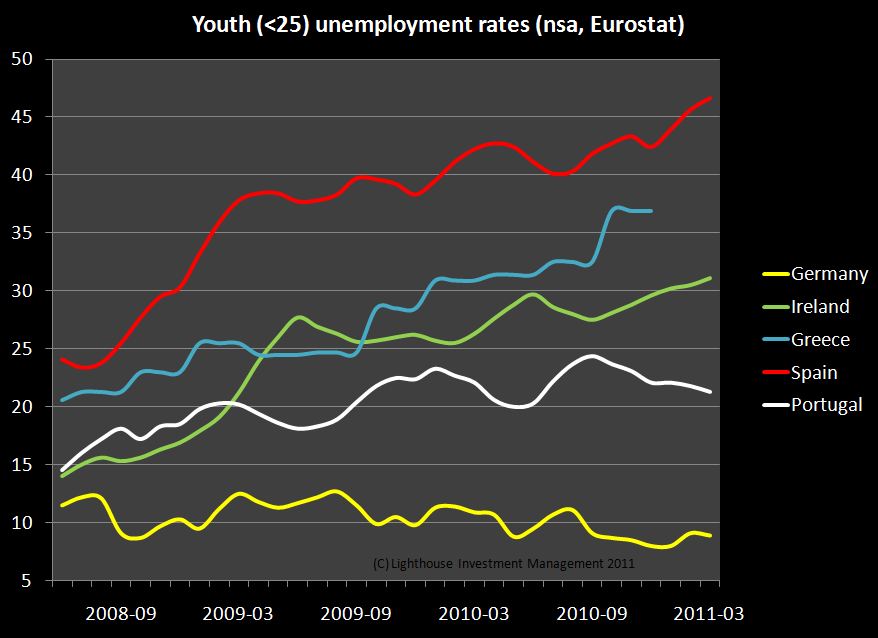
Spanish Elite Say: Let Them Drink Sangria.

Looking at these pictures from Barcelona one would think this is Tunisia, Cairo, or at best, Athens. Instead, it is from the once incomparably wealthy capital of Catalunia (although they did have Olympics there: an event guaranteed to result in at least one municipal bankruptcy at some point in the future).
sytsew_27-5-2011_29web
sytsew_27-5-2011_01web
sytsew_27-5-2011_06web
sytsew_27-5-2011_05web
sytsew_27-5-2011_02web
sytsew_27-5-2011_03web
sytsew_27-5-2011_04web
sytsew_27-5-2011_28web
sytsew_27-5-2011_07web
sytsew_27-5-2011_11web
sytsew_27-5-2011_13aweb
sytsew_27-5-2011_13bweb
sytsew_27-5-2011_13cweb
sytsew_27-5-2011_15web
sytsew_27-5-2011_14web
sytsew_27-5-2011_13web
sytsew_27-5-2011_17web
sytsew_27-5-2011_20web
sytsew_27-5-2011_21web
sytsew_27-5-2011_23web
sytsew_27-5-2011_31bweb
sytsew_27-5-2011_32web
sytsew_27-5-2011-31aweb
samuel_rodriguez_desaolojo_bcn_12
samuel_rodriguez_desaolojo_bcn_11
samuel_rodriguez_desaolojo_bcn_9
samuel_rodriguez_desaolojo_bcn_8
samuel_rodriguez_desaolojo_bcn_7
samuel_rodriguez_desaolojo_bcn_6
samuel_rodriguez_desaolojo_bcn_5
samuel_rodriguez_desaolojo_bcn_4
samuel_rodriguez_desaolojo_bcn_3
samuel_rodriguez_desaolojo_bcn_2
VincenzoRigogliuso_27-05-2011-030
VincenzoRigogliuso_27-05-2011-029
VincenzoRigogliuso_27-05-2011-028
VincenzoRigogliuso_27-05-2011-027
VincenzoRigogliuso_27-05-2011-026
VincenzoRigogliuso_27-05-2011-025
VincenzoRigogliuso_27-05-2011-024
VincenzoRigogliuso_27-05-2011-023
VincenzoRigogliuso_27-05-2011-021
VincenzoRigogliuso_27-05-2011-020
VincenzoRigogliuso_27-05-2011-019
VincenzoRigogliuso_27-05-2011-017
VincenzoRigogliuso_27-05-2011-016
VincenzoRigogliuso_27-05-2011-015
VincenzoRigogliuso_27-05-2011-014
VincenzoRigogliuso_27-05-2011-013
VincenzoRigogliuso_27-05-2011-012


VincenzoRigogliuso_27-05-2011-011
ramon_27_05_11desalojo-40
ramon_27_05_11desalojo-39
ramon_27_05_11desalojo-38
ramon_27_05_11desalojo-37
ramon_27_05_11desalojo-36
ramon_27_05_11desalojo-35
ramon_27_05_11desalojo-34
ramon_27_05_11desalojo-33


ramon_27_05_11desalojo-32
VincenzoRigogliuso_27-05-2011-041
VincenzoRigogliuso_27-05-2011-040
VincenzoRigogliuso_27-05-2011-039
VincenzoRigogliuso_27-05-2011-038
VincenzoRigogliuso_27-05-2011-037
ramon_27_05_11desalojo-31
VincenzoRigogliuso_27-05-2011-036
VincenzoRigogliuso_27-05-2011-035


VincenzoRigogliuso_27-05-2011-034
VincenzoRigogliuso_27-05-2011-033
VincenzoRigogliuso_27-05-2011-032
ramon_27_05_11desalojo-30
ramon_27_05_11desalojo-29
ramon_27_05_11desalojo-28
ramon_27_05_11desalojo-27
ramon_27_05_11desalojo-26
ramon_27_05_11desalojo-25


ramon_27_05_11desalojo-24
ramon_27_05_11desalojo-23
ramon_27_05_11desalojo-22
ramon_27_05_11desalojo-21
ramon_27_05_11desalojo-20
ramon_27_05_11desalojo-19
ramon_27_05_11desalojo-18
ramon_27_05_11desalojo-17
ramon_27_05_11desalojo-16


ramon_27_05_11desalojo-15
ramon_27_05_11desalojo-14
ramon_27_05_11desalojo-13
ramon_27_05_11desalojo-12
ramon_27_05_11desalojo-11
ramon_27_05_11desalojo-10
ramon_27_05_11desalojo-9
ramon_27_05_11desalojo-7
ramon_27_05_11desalojo-6


ramon_27_05_11desalojo-5
ramon_27_05_11desalojo-4
ramon_27_05_11desalojo-3
ramon_27_05_11desalojo-2
ramon_27_05_11desalojo
VincenzoRigogliuso_27-05-2011-010
VincenzoRigogliuso_27-05-2011-009
VincenzoRigogliuso_27-05-2011-008
VincenzoRigogliuso_27-05-2011-007


VincenzoRigogliuso_27-05-2011-006
VincenzoRigogliuso_27-05-2011-005
VincenzoRigogliuso_27-05-2011-004
VincenzoRigogliuso_27-05-2011-003
VincenzoRigogliuso_27-05-2011-002
VincenzoRigogliuso_27-05-2011-001
corpselu_27-05-2011_catalunya_lliure


corpselu_27-05-2011_catalunya_lliure


corpselu_27-05-2011_catalunya_lliure


Why?
¿Por qué?